While I'm stuck in the middle of my book, I reflect what the new year brought us.
Heartbreak, misery, and shock.
But just because your life sucks doesn't mean you should give up.
It means you have something to say.
The world hurts and our words are supposed to heal it.
What about healing the writer?
Can our own words soothe us or do we selflessly reveal our souls to help others find their own?
Misery wants to empathize.
We want to relate.
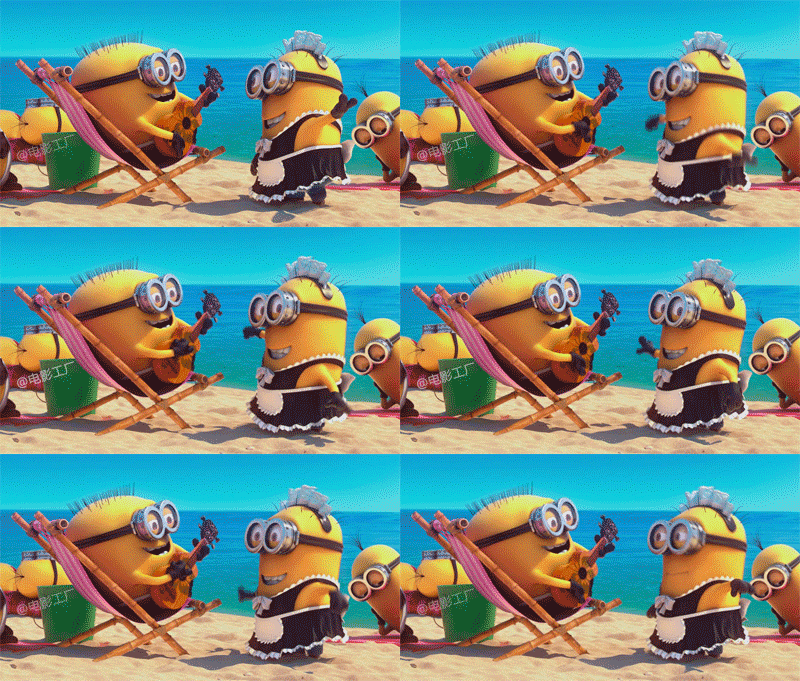
(Yes, this is a happy photo I took. There have been no gloomy days here so I've been extra cranky. I need my gloom or all the happy irks me. Balance, people. Works both ways.)
1. Brings Value 2. Makes You Relatable 3. Strong Emotions Produce Best Results 4. Therapy for Writer and Reader
Which writer did you relate to who had horrible experiences? Maybe you didn't relate, maybe you just felt their work was beautiful. One of my favorites is Edgar Allan Poe. If anyone read his work, they have at least one favorite. With my disturbing perspective of what's beautiful, his violent poetry speaks to me. It's dark but it's honest. He lost so many in his real life that his only outlet was writing.
Now what if he lived a happy life? Annabel Lee would not have the same impact.
When darkness veils your life, it's an opportunity to create. When Alan Rickman died, my soul broke. Didn't want to do anything that day. I got drunk and cried. My years of drawing fan art, writing fan fics, and watching his films three-fourths of my life led to a very miserable week. After I sobered up his day of death, I painted. I had to. The brushstrokes were therapeutic. I didn't hurry it up to post my tribute with everyone else, I just painted for my soul's sake. 21+ hours later, I submitted my tribute on my art page. For miserable reasons, it ended up being my best work yet. I handled every detail with perfection (as much as I could). This is one version:
Didn't sleep. Didn't eat much. Even stopped drinking. Cried a lot watching my painting become him. Skipped the Bargaining stage. Disbelief, Anger, and Sadness mostly. I shouldn't use my emotions to work, but sometimes I need to. It produces the best results. If I didn't find a way to channel my emotions, I would've kept drinking. Not good for anyone who depends on me.
Another way I coped with tragedy came more immediate, years back when my dog died. I never got serious about writing until his death. I had to write. I promised him.
It still hurts.
My first book leaks my loss of the greatest friend ever. People will find solace in their loss through acceptance of death. That's my hope, anyway. Nobody should deal with that alone.
Our darkness is what gives us value. Without miserable moments, we can't be relatable. Total misery is doom but if we find the balance to accept the light and dark, then we can find the words to make writing worth reading. I'm not saying be miserable all the time. Not saying be happy all the time either (ugh...that's the worst...so fake...hate fake, all-happy people). But we can't help what happens to us. We can help what we do about it.
John Berryman Virginia Woolf Edgar Allan Poe Tennessee Williams Hunter S. Thompson Ernest Hemingway Robert E Howard Anne Sexton Sylvia Plath
And again, not saying misery is a good thing or that we should glorify it, but successful writers had awful lives. Certain all these committed suicide. If you think your life sucks and are not talking to someone about it, don't keep it in. Seek the light. Sometimes writing won't be enough to soothe your ache. I want you to find hope. Every aspect of your life is meaningful, even the misery. But if it hurts too much, please--please--don't keep it to yourself. Those stages to suicide are bullshit. My friend died and no one saw it coming. Wanna talk? I'm here. Seriously.
This post is a mess. No apologies. Talking about misery where spots are still sore is not my favorite, but I have to, especially if it helps you.
First thing I hear about rewarding yourself includes food. Buy an extra sugary coffee, go splurge on ice cream. I treat all my reward systems like I treat my fitness one: the healthy, non-detrimental way. Certain foods may not have the same effect on you as it does me, but if I carb load or have one too many sugar yums I am in a coma or just the laziest person ever. If I start writing again after I rewarded myself with sugary snack, I will fall asleep with my hands on the keyboard, and nothing further accomplished.
How should we reward ourselves? Rewards should improve our state of mind, alleviate stress, and I know you're thinking "sugar alleviates stress and improves my state of mind", or "beer alleviates..." "chocolate improves..." and I say, you will use it as a crutch and it will break, and drown you. I know. I've been there. Using food as a reward leads to more food and more food and--oh look at that, I will have gained back every pound I ever fought hard to get rid of since I started my weight loss journey back in 2011. Yes, people. I'm bringing this up because I used to be fat and I will not be fat again. I hated how I felt and food reward systems are dumb. All food reward systems will lead me back to how I was. If you are working tirelessly to lose weight, maintain it, or just be healthy--maybe you're starting your nutritional awareness and want to find other means of rewards--this is the list to inspire you to not pick up that donut because you just sat there for hours upon hours and met your word count goals.
New Book or Journal
Staycation
Venture Out
Exploit Capitalism
Hire Loved One as Servant for a Day
1. New Book or Journal
Every writer loves paper. Every writer should be reading books to absorb the finished product of other writers, either as entertainment, or to be inspired, or as personal development. I call it personal development because, truly, I don't like reading. Why do I not like reading? Because I love reading and I am constantly bombarded by crappy books, or at least crappy starts. (I will prey forever on the gnawed bones of Veronica Roth for betraying her fanbase.) What makes me giddy is paper. I think you love it too. Don't hide it. Embrace it. Have you reached 5k words in a day? Go out and grab new materials for your writing wantiez and needz. It's okay if you buy another pack of colored pens even though your drawer is stuffed full of them from years of gathering.
I am the Squirrel of Pens. Hear me squeak.
Squeaker squeak squeaken.
2. Staycation
Yesterday I thought this was a great idea. The sun shined, I was done writing by 1000, I got my workout done by 1200, and all I wanted to do was try, and grab those rays with Vitamin D before another rain cloud hit.
(Hawaii in fall is all rain and wind or solid overcast. It's been rare to see the sun for longer than half a day. Like right now...it's pouring out. It could be all sun northshore, but I don't know. Never trust Hawaii weather. It's the mistress of deception. lol...anyway.)
I took the rest of my day as a sign to unwind. I fed my child and I and, while he played, I lounged in the backyard, and read. Personal development and Vitamin D. Spf 8 so I can stay out longer and I got to live in another writer's world for hours. I sharpened my most important writing tool and got great nutritional value out of the elusive sun. Win-Win (that's Franklin Covey, btw.).
Take the time to enjoy your home. You don't have to read. Maybe you're sick of reading and just want to play video games. That's cool too. But stay on schedule. Don't tune out the world for too long or you'll wonder what happened to the years of your life.
3. Venture Out
Got family? Take them with you. Go to the beach, a bounce house, or a park. Is it raining? Good. Splash in the puddles. Be a kid again. Enjoy life. Enjoy the oxygen. This one isn't about going to the movies or staying indoors. If you're writing a book that involves the environment, get in the environment! Remember the smells and the feels. Remember what triggers certain thoughts. Don't write it down! This is to live in the moment with yourself or with kids or with your lover. I got a friend who just took her Honeymoon over to Kauai. She's venturing out to Haleakala Crater, and hiking the Na Pali coast, and she just took a helo to see the stuff her feet will miss. A gorgeous place to be (another place where you cannot trust the weather). You can even play a game. Become one of your characters and respond to the world as they would. Did they take a lunch break? What did they order? Have they even seen this century before? That should be even funner. Oh yes. I said funner.
Enjoying the Outdoors now?
4. Exploit Capitalism
You knew this was coming. I don't like to shop unless I know what I'm looking for and then my mind goes into different trails of importance and I remember things I needed to get, so I end up shopping longer. But this is where I need you to focus. I'll try to focus too. FOCUS! Okay. Buy ONE thing that is a luxury item that does not count towards your writing. It can have writing inspiration stuff on it, if you want. But I want you to steer away from buying binders or paper. Omit tools or personal development. Got it? Make it count!
Shoes
Clothes
Jewelry
Accessories
Cosmetics (oh you know this includes nail polish! Eeeee!)
Lotion or other Hygiene Luxury Products
Candles
Phone case
Framed Print
Video Game
DVD/Blu-Ray/3D
Recreational Item
What did I miss? Most of these shouldn't blow a budget if you have one. Just count it under luxury (Dave Ramsey can help you, here, or I can give you a quick rundown--message me) and enjoy the purchase. No buyer's remorse, please. One item. Keep it simple. Cash or Debit. And know that it was purchased from your hard work!
5. Hire Loved One as Servant for the Day
You have told them you're doing NaNoWriMo. You told them it's going to be hard and they should forgive you for any snappy comebacks or lashing-outs you might make. You have done well. Very well. So well in fact you can ask them to pamper you. Do so respectively. You're not a queen or king, but if you say "hey, may I take a break for the day, and you help me relax?" I guarantee they will do their best to make this happen. If not, reconsider who your loved ones are. Unless they're sick or just got off work from 24-hour duty, request it. My husband tells me every day he's super proud of me for doing this. He watches me type insane amounts of words. Insane in my book is over 2,000, because life as a mom does not usually let me write that much in a day. Yet I am performing mommy writer miracles. I ask him to take care of the chores for the day and he has no problem.
If you can find a day for your loved one to do this for you, so you don't have to stress about the house being a mess, or you being a total dirt bag and not bathing for two days (accused and guilty), make it happen. Have them run you a bath. While you're soaking, they'll do the dishes, or make dinner. If you're a working family, do this over the weekend. If they must treasure their days off, then just have them do a chore or two that you would usually do. We're a military family so all off-days are precious. But my hubby can deal with cleaning the kitchen so it's not dragging through my mind when I also need that precious off-time.
NaNoWriMo?
Good heavens, Master Wayne.
I do think you're in over your head.
After you're done with NaNo, maybe you can pamper them back. It's a balanced relationship. It's supposed to be anyway. Both of you serve each other. Both of you love each other. Let them show you. And you show them.
Don't pamper me, sir.
= = = = = = = = = = = =
Avoid the junk food. It hinders your production and leaves your body feeling icky. It might release those endorphins for a time, but you'll be hurting.
You are worth being healthy. You are worth taking care of yourself. Don't let yourself or anyone else tell you different. Find the healthy rewards. You'll look back on it later and be thankful you did.
One last thing: don't reward yourself for every little thing.
Make a challenging goal, set it, and when you reach it, choose your reward. Is it to break your word count of the day from 2,000 to 5,000? Or maybe 750 to 1,500? Is it to reach the NaNoWriMo badges, like 10k or 25k? Make the goal short-term and when the long-term goal is achieved, it's a whole new sense of accomplishment that may be a reward in itself.
I know when I finished my first novel, I was on top of the world, and was so excited about the second, that I just ran right into outlining the second.
My rewards for finishing the overall goal were: (1) calling my parents late night, waking them up, and regaling them about my hard work; (2) posting photos of the final word count (120k+) and a happy selfie to smear in any haters' faces that were stalking me; and (3) cuddling with my son, knowing I just achieved one of my lifelong dreams, and just basking in the afterglow of hard work, determination, and consistency.
You can do this. If my once-procrastinating butt can do it, you can too.
I edit my photos like I write. I want clarity and subject. I want to know exactly what I'm looking at. I want all the distractions out of the way so I can admire the view. If anything hinders that, I toss it. First rule: dump the blurry photos. Doesn't matter if it's a great shot; it's not a great shot if it's blurry. There are some I keep just for myself, like if it was a once-in-a-lifetime catch of my kid, but just for me. I don't post it for anyone else. Blurry makes the entire subject an eyesore. If people treated writing like I do photos, there would be more intriguing things for me to read. Like I toss my photos, I toss my books. If I see excessive use of narrating (someone telling me about something, and not letting me experience the moment through the character), I close that book. Especially first couple pages. I'm super picky because my time is valuable. I don't want to waste my day reading a book that could be good. I want to know it's good. (The Shack is still the crappiest book in existence. I don't care how many Christians try to tell me otherwise. I tried three times. I threw it three times.)
The huge turn-offs in reading are found in six eyesores of writing. Want your reader to keep turning the page? Dump the blurry photos.
The 6 (6?) Eyesores:
1. Passive Voice
2. Distracting Prose
3. Said Synonyms
4. Type Usage
5. Telling
6. Cliches
#1 Passive Voice
Active: Sam stabbed Tallis in the face.
Passive: Tallis' face was stabbed by Sam's knife.
Active: I ate the cookies.
Passive: The cookies were eaten by me.
Active: Active is aggressive and hits the point.
Passive: The point which Active hits is aggressive.
Nobody likes beating around passive entrails except politicians, so keep your voice active. In Active, the subject makes the action. Have you ever heard someone talk indirectly? I'd hate to bring up politics again (passive-sounding, did you catch that?), but they're so good at beating the dead Passivity that it's eye-rolling. During the Benghazi hearings, Clinton couldn't come up with a single Yes or No answer. "That could be correct." "That is possible." And so on. Besides making my military blood boil, she makes every use of INDIRECT voice, aka passive. She can't own up to the responsibility of the subject's actions.
Your job is to own up. In dialogue, you need your characters to get to the point because that's what your reader wants. Unless you have that conflicting character who's making life hard for everyone, or is trying to keep a secret. In which case, Clintonify the crap out of that dialogue. Annoy your other characters and annoy the reader. Then at the end of the book, make someone punch that character in the face, because that's what the majority of your readers will want to do.
#2 Distracting Prose
Those over-elaborate details of setting, the character's description (even though the character may not even be noticing these things about themselves), the long sentences with too many adjectives...
...stop it. Read some Stephen King. They're "scary" books. So what? Know what's scary? An angry reader with a tome in their hand waiting to chuck it across the room.
When you're writing journalism, you do not use filler words, especially in the first paragraph. News is news, not excessive poetry. In this age, people are fast-paced. Make it so the fast-paced people want something to read in the short amount of time they have between checking Facebook, Twitter, Tumblr, and calling Mom before lunch break is over.
In fiction writing, don't overstep the "crisp, clear blue water cascading the mountainside, splishing with plumes of mist that cast a veil over the--"
I threw the book away at "crisp" and "clear". I used to write like that. I still might. If I do, and I notice, I growl at myself. Grrr... Yep. You're not the only one I'm hard on. *snorts* Difficult with. That's better. I spend enough time catching myself in my own errors, I really don't need others to do it for me. Color Code Personality: Blue. That's me. Honesty and Rules. I love them. I love rules. I know when to bend them but in distracting prose? No bendy! No breaky! Get to the point!
If you're going into descriptions of setting, make it a short paragraph. Practice journalism and realize what's really important for setting. What is it that your character notices? If it's a male character, do you think they'd notice what shade of pink some girl's lips are? What type of tree they're leaning against? If you leave out detailed descriptions, you give freedom to your artistic fans. You know...the ones that like to draw fan art. Yes. Make them happy. Give them freedom. Make them imagine for themselves what kind of tree he's leaning against. Unless he's an arborist. Then go nuts. But guys don't care about shades of color.
#3 Said Synonyms
One of the best poems I listened to used said over and over again. It didn't matter because it was about the dialogue.
If you keep the "saids" monotonous, it won't distract the reader from what's being said. Fuss over synonyms because you think you said "said" too many times and you're overthinking it. There's a post going around on Pinterest, talking about different ways to say "say"......do not like this. It's for amateur writers who aren't ready for the big books yet. If you're worried about using "said" then you're going to slow yourself down.
I use said even when I know my character is screaming. I use an exclamation point when a character shouts. The exclamation does the shouting for me because I don't use it often. And you don't need to make fence posts out of it.
!!!!!!!!!!!!
#4 Type Usage
Italics. Underlines. Fence posts. They're distractions and the reader will come out of your world because they'll notice they've been reading. You don't want them to notice they're reading. You want their eyes to move over words, vessels into your character's eyes. Make them become the character. Type usage goes into deep perspective, or deep point of view.
Leaving out italics kept the words moving. It's Svetlana's perspective, so all words will be hers. The reader is in her head, so any use of italics to show she's thinking is irrelevant. Any underlines for a word she may strongly pronounce isn't necessary if the sentence structure is written well. The reader will get which words are emphasized. They're smart. Let them show you how smart they are. Svetlana wouldn't have an impact on the situation with Caelum if the reader had to read this:
Svetlana looked down at her hands.
If it were that simple then she could just turn her skin to ice.
Her hands frosted over into an amethyst hue.
Now I'm just telling you what she thought with type usage. You're not actually feeling it.
#5 Telling
Will Smith's character in Men in Black brought the viewers along for the ride in the world of sci-fi. If he was just sitting at Kay's desk, being told all the happenings of his new job, there wouldn't be a movie.
Show don't Tell.
We mean it. Get rid of the She thought, he thought; he realized, she saw. It'll look like the story is told to the reader, not the character going through the story. Telling is narrating. Narrating is bad, mmmkay? A character's thoughts are the words. Let them go.
Example:
“Holy spades on a rainy day. Did you quad-shot this?” Darlana asked.
“Only for you, my dear.”
Darlana plugged the port into the register; it beeped, and she placed it back in her pocket.
“You are a blessing,” Darlana said, walking away.
The straw never left her lips from the stand to outside. She even maneuvered herself onto the bike without having to drop the cup in her custom holder. How long was she at work for? In all the gloomy, rainy days, today turned out to be clear, and glistening. As Darlana pedaled (one hand on the handlebar), the chilly air nipped her face; she took in the scene, eyes glancing at the array of flowers and bushes about the parking lot, and the birds singing in the trees.
What a perfect day—away from the curse of monotony, away from judgement, away from the hassles of survivalism. She had a credit port to unleash on the sinking ship of capitalism. What a better place to go than where a girl can drown in a sea of fashion: the shopping center.
* * *
Getting coffee is a favorite pasttime, even for characters. Makes people happy. Makes them do things. Splurge, even. A fantastic example (not of coffee) is in The Shining, where Stephen King pulls us into Jack's mind, and uses deep perspective to make us feel Jack's experience. The movie isn't as personal as the book; recommend reading it to gain insight.
#6 Cliches
One of my problems as a writer is coming up with ways to twist a cliche into something original. Watching shows and hearing the characters talk and know exactly what they're going to say--. Hello, eye roll. I went to a writer's workshop where Brad Bell and Jane Espenson discussed several topics, including this one. They showed us a screenplay Bell did with Husbands (?), and how the character said "elephant in the room" without saying it. It was brilliant. They said, "Wow, how'd that elephant get in here" or something like that. I have the screenplay somewhere in my folders. If you catch your characters saying cliche things, maybe because you're just spitting out dialogue, and those words are the first things that pop into your head, then go back, and re-direct the phrases.
In the earlier text, I wrote "beating around the bush" without saying so, but you got the idea. "...beating around the passive entrails..."
It's time we get creative with cliches because there truly is nothing new under the sun...oh look at that...a bible verse. I wouldn't redirect anything from the Bible...but if it needs to be changed in your book, do so. I'm won't leave God out of anything, though. Bad things happen. O_o (<---oh look! distracting type usage!)
Cliches don't have to be about dialogue, either. Characters and genres play into it. I used cliches in my first book to make a point, that not everything is entirely cliche.
A mad scientist is one layer, a bad German accent is another layer, but add everything else into the story--like how he's not so mad, and he's actually a bio-engineer, and he really is German but only his accent comes out when he's stressed, and some other things I can't say cuz it would spoil the story of my first book...
But everyone loves a mad scientist. And everyone makes them their own style. In order for your audience to care about them, there has to be more than mwahahas and crazy hair.
Practice twisting the cliches. Watch what you say and see how people react. Watch a cheesy show. Once Upon A Time is good. Most of what they say on there is total cliche. Sorry, Espenson. I don't know what the writing team was thinking. Riding old characters for several seasons is a Hollywood cliche in itself. Make something new. Stop reliving old ideas. It was nice at first. Now?
Now I'm ranting. I gotta get outta here!
One week until NaNoWriMo. Are you doing it?
I am. Blogs will be shortened for November, if they exist at all. Maybe I'll post crazy somethings to inspire you, or terrify you, into doing NaNoWriMo next year. XD Fun times.
Apologies if my posts for this week and next seem distracted. I have good reason: my husband returned from deployment! Yay! We've missed him fiercely, especially our little monster. Happy to be under the same roof again.
We're Whole Again
As a military family, we are bombarded with obstacles. We signed up to serve our country (yes, I served for a while, but got out when we had our son) and face conflict only 1% of this nation will ever experience. Those conflicts are why I love fantasy genres. Anything to escape our reality is the best story, as long as it is, really, the best. I want a book that entertains and steers my mind from current events, the real world. I want conflict that I won't deal with if I was at sea or at home. I want an escape.
But I also want to relate to the characters. Conflict with unappealing characters means I close that book, either putting it down, or throwing it across the room. Maybe I won't even touch it at all...(cough) Twilight.
I mean no one is going to care about my husband working in the Navy if they don't understand why he puts up with the deployments all the time. There's conflict and then there's character. It's characters that drive the story. Conflict only propels them to reveal who they really are.
One reason I started writing is because I got sick of people eating up these awful books that have the weakest female characters in the world. They're not role models and they sicken me. They get published and I can see why: the conflict is believable in its genre, but the characters are lacking for some reason. Maybe it's just me, but I don't find boring personalities entertaining. They're...boring. Or annoying. This usually happens when their motivations are lackadaisy.
So how do you get out of that rut? I have some characters that I debate on allowing their existence. But I set them aside because I know they're not ready to tell me who they really are. Or I have characters that I never knew existed and there they are. My prot goes into another world and I'm just as surprised as she is to find out all the different people that live there. And it works for me. If I'm not intrigued, the reader isn't intrigued. It's a journey I love to go on despite my need-for-control quirks. Because if the story isn't driven by the characters you know and not know, then the story isn't believable. The conflict is there but the characters are who go through the conflicts. If you force them to go through the motions to solve situations, readers will know.
I can go into great detail on creating characters that aren't boring but that's very basic and I think new writers have more potential for nailing this part than they do balancing out conflict with character. So let's focus on the balance.
What is CONFLICT? Anything that hinders your character to satisfy her desires. Much different from a delay or incident, like a gun just out of reach when a victim falls while the attacker is closing in. The conflict is the attacker, not the delay, which is the gun inches from fingers.
Conflict will exist when your character has a goal. Make this goal clear to your reader.
For example: (Goal) Svetlana wants to be her own person. (Conflict) Her father, Ruslan, forces her to join the military.
The conflict will elevate when both try their hardest to achieve their goals. What makes this more dynamic is understanding the inner conflict that goes with the external. Sveta's external is her dad, and her internal would be her rebellious nature, or maybe her insecurity to stand up to him.
And goals will change because the person changes. And that's fine. What is important is that the reader must care about the character before the conflict matters. Most readers are character-driven. Humans are social creatures and naturally seek connections with others. If they don't care, they won't read. The conflict will bring the story to life by the character's motivation to reach their goals, and the reactions brought on by the conflict. Your story's core is emotion. Why is the character pushing through to the end? Why should we care? Answer these for yourself. Ensure your story has characters we'll care about.
In the book Writing with Emotion, Tension, & Conflict, Cheryl St.John writes this principle: "What the character is doing is not as important as why he is doing it. What's happening is not as important as how he reacts to what's happening."
I highly recommend this book to study her take on conflict, although I disagree with her when she says that being angry and bickering "is acceptable for antagonists because it characterizes them, but your protagonists must have more depth." She talks about conflict not being the foot-stomping moments. What I disagree with is prots being more in depth than antagonists. The ant and the prot should be equally-motivated, if not more.
Antagonists are the ones with the most depth, I have read. They are the characters I love because they have relatable reasons to do what they do. You see? It's character-driven, not conflict. When the story has two characters with believable motivation to achieve their goals no matter what conflict, it makes for a more compelling read. When you adamantly know every character's motivations, you will soar through your writing. And St.John also explains this. And I agree with her. But let that antagonist shine.
Find some writing exercises to help develop your conflict and understand your character's motivations. Choose your protagonist, and come up with one sentence to describe their goal. Is their goal based on the conflict or is it based on personal desires? Will their goal change throughout the story or remain the same?
Do the same for your antagonist. Are they the conflict to the protagonist or is it something else? Will their goal change?
How might each character's inner conflict fight their external conflict? Will they think one way and act another?
Have fun this weekend! I'll be spending quality time with my sailor and catching up on some personal development. Later kiddos.
One of the funnest things I get to do as a writer and artist is submerge myself in the characters. Often, I walk around the house responding to common chores as they would, and see where it leads. While I'm doing the dishes, I'm talking out a scene. Showering, singing their theme songs, or imagining their scene according to whatever instrumental I've chosen. And this is me taking a break from writing.
The brain never stops. Curse, meet habeñero-chocolate-coated Blessing.
What do you do when you've exhausted your writing? Or you've tripped over a character block? Because you're not understanding the character enough, your story doesn't seem dynamic enough, maybe even believable. Maybe it's boring. Whatever the reason, you tired of the work; so do your characters. Time to take them out for some casual entertainment.
Yes. A date.
Pick Your Person
Pick Your Place
Pick Your Picture
Go to Town (or park, or studio, or...)
Archive it
Pick Your Person
Pick one you don't know very well. Maybe pick one you really enjoy (yep...exactly like a date). Is it a double date? A group? Just you plus one? You're dating to get to know them and let off steam. Make it count, especially if they like you. My antagonists usually say so, but then they don't call for a week, and I'm forced to torture them with the protagonist's success. That's what they get.
Pick Your Place
Set the setting. Set the mood. Set the table. Your table, actually. Or lap. What's your medium? You're not limited but since I can draw, we'll focus on that.
What are you doing with your character? Concert? Ballroom? Deli? One of my characters happens to really like sandwiches.
Pick Your Picture
If you haven't figured it out, the whole date thing is just getting you to pull out that sketchbook, and think about your character outside the story. Take my two protagonists (prots), Sven and Darlana. These scenes are nowhere in the book, but I wanted to see what these two would do between the chapters. Darlana's drunk face, the serious catwalk strut from an explosion (maybe) straight to lunch--all of this helps the writer see what kind of friendship the prots would have outside the plot. Think of your antagonists (antas). What would they do?
Some of my sketches never become line art or colored. I just keep them for the sake of enjoying the character. Seeing them with other characters, seeing them with me, makes writing so much easier. You're building a relationship with them. The more you love them, the more you want to write, and write well. And some others might benefit from the sketch as reference for their own work. I like to share as long as people don't steal.
Go to Town
Have a blast!
There are many ways to date your character. You can even try and be them. Take my expression reference for Sven:
Charismatic character? You'll want to keep references like this on a wall somewhere as a cheat sheet to know what tone and personality boundaries you can't cross. You want to be consistent in your writing. And knowing what your characters do in their spare time, deepens your knowledge about them.
Sven isn't the dull type. His dialogue doesn't show it, his face doesn't show it. You might even hear his accent through these expressions alone. He is one of my favorites. (Bradley Cooper is his lookalike, by-d-by.)
Archive It
Keep your sketches handy! Use them as you will. Find other people's references and, if they say it's okay, work off theirs. I have my own art website you can go to see these drawings. Always keep your sketches. I have a folder that's like a scrapbook. But some of these sketches are on my wall to keep them fresh in my mind.
Hope this gives you some idea of lightening the writing mood when you're not writing. If you're on DeviantArt also, +watch me and I'll watch back. Later kiddos!
I struggle every day to motivate myself out of bed, turn on the Keurig, and sit in one spot and write until my four-year-old wakes up. His waking occurrence can happen five minutes after I start typing, or four hours later, when I kick myself for not making lunch. I am in no way an expert, but I found, throughout my years of writing, a few life hacks to get you going:
Minimalize Your Workspace
Find Your Habits
Psyche Yourself Up
Personal Development
Eat Simple
Focus on your Triforce
#1 Minimalize Your Workspace
Not minimize. Minimalize. Some photographers have a style called minimalism, where less is more in their shots. You must be free of distractions. Your work space is your sanctuary for your characters and you must treat them with respect. You are torturing them with plot and could possibly kill one of them. Being respectful is the least you can do.
Consider your space like a date scene. You have a date with your book and all the characters want your attention. You don't talk to them while you're playing a game on your phone, or have sidebar with someone else in the room. You just don't. Unless you're talking to yourself (which could be #2 or #3 on the list) you can't afford wasting your characters' time. You have a world to suck people into. Simplify your holy ground and get to work. You have torture to do.
#2 Find Your Habits
All writers have them. You don't have to copy them, maybe you just want to try them out, but you need to find you. You find you by figuring out your quirks, your weaknesses, your strengths, and your style. This comes with every day practice. Some writers couldn't write unless they were naked, or not wearing pants. Some had to be outside, some had to be hiding in a loft.
I have to wear a beanie.
Said beanie.
I caught myself playing with my hair with one hand on the keyboard, not doing anything but re-reading my work, or staring blankly at the screen. I put a beanie on my head one day and both hands got busy typing. The distraction was gone. My habit was curbed. Now I don't wear a beanie all the time...but it helps when I have a very hard time focusing.
#3 Psyche Yourself Up
What's your style? What helps you get your muse in gear? There are different learning styles for people just as there are inspiration styles.
Consider creating a playlist for your book. You're in the shower and you play songs that get your imagination going.
(Confession: I do this all the time, even sing out loud, and pretend the characters are right there in front of me [clothed and dry, mind you...sometimes], either singing along, or acting out a scene. It helps me organize my story, especially if I'm struggling with moving the plot along.)
I also have playlists for each major character and mood lists, depending on what mood I need to get into to write specific scenes. I have battle sequences, death, love, sex, nostalgic, etc.. I read somewhere that Audiosparx is where filmmakers go to nail the perfect track for their trailers or movie scenes.
Some inspirational music I have is from Two Steps From Hell and more well known composers like Hans Zimmer. I collect soundtracks so I can't list them all, but Two Steps From Hell is a great starting point. "Archangel" will always be my favorite when I need to get into the action scene mood.
I did mention weaknesses in #2. Your weakness can be your undoing; you can overcome it if you know what it is. Mine is perfectionism. I overcome this by whole-heartedly knowing people must read my story. They will love my characters as I do and they will love the world I pulled them into. If I don't write, I lose my mind. This is my passion. And no dark whispers in my head saying I should just give up because I will fail can stop me.
Psyche yourself up by looking through Pinterest and finding motivational quotes from authors. Make your own board of all these (mine is called "Brie's Self-Motivation Vocation") and read them. Guaranteed one of them will spark something in you.
If you're still struggling, I would print out pictures that motivate you, or draw pictures of your characters. Draw your own fan art. As an artist, this is fun to do when I'm not writing. I draw them out of character as well. You gotta lighten up sometimes. Torture miserable characters with happiness. You might just kill them outside your story. Mwahahaha.
#4 Personal Development
Reading about writing for at least fifteen minutes will sharpen your writing skills, especially if you do this at least once a day. So take that fifteen and read a writing book. K.M Weiland and Angela Ackerman have great books on Amazon. A good writer always has learning tools in their arsenal. Buy a couple. If you're pressed on money, buy the one book that you would really benefit from. Mine was "How to Write a Novel in 90 Days" to get through my first book. I didn't make it in 90 days but I made it further than I ever would have. And I finished, so that says something.
You'll hear from dozens of people how they want to write a novel someday. Maybe you're one of them. Be that person who actually commits. Don't wait around for something tragic to happen in your life to get you started (yes...like I did. More on that another time.).
#5 Eat Simple
I don't mean go out to a fast food joint and overload on calories (that'll lead you to a carb coma), Stay in the house, fix something quick, eat it, then get to writing. I will post another blog on fast nutrition that's healthy and helps your brain focus. For this, I will say avoid making omelettes or other time-consuming products. Being a Beachbody coach, I have tricks to help you stay on track without slaving away in the kitchen.
In the morning, I usually make Shakeology, but if I don't want to make a lot of noise, I make a cup of greek yogurt and granola, or cottage cheese and berries. It takes less than five minutes to prepare and my brain will thank me for fueling it something besides black coffee.
#6 Focus on Your Triforce
Mind, Body, Soul.
Your soul is the writing but your mind is conflicted, your body is tired, and your soul has temporarily lost its passion.
Your body craves something physical or nutritional. If it doesn't get exercise or proper food, your mind loses focus, and your soul is left to wait, buried in a weak body.
Your mind is not learning; it's bored and all those perishable skills are waning. Your body is sluggish and your soul cannot be happy with a distracted, lazy brain.
Your soul is not being fed things that make it happy. You're not relaxing and are worried about work, school, or fitness. Life is getting in the way of actual life: your purpose.
This is the balance of life. We have to find a way to keep our Triforce in check because if one piece fails, they all fall apart.
Personal Development helps with mind issues, but so does going to Bible Study, or meditating, or avoiding family drama. Learning something new every day makes your wit sharper and your curiosity satiated. Watch the mental stress levels.
If work is straining you, try soothing your soul with a hobby, which may help destress you. If my husband comes home from work (yes, I said if. It's a military thing.), he'll either watch TV, or play video games. He doesn't want to deal with physical stress, like playing with our kid. He may try, but Tag is out of the question.
After I clean the house and run errands, I like to write, draw, or game. I also have a habit of running out of the house before sunset with my camera gear, and practice shooting. If you don't believe me, I have a Flickr account here. And this is one of my shots (it is available for print):
For balancing the body, I cannot stress exercise enough. I used to be very overweight and was miserable. There was no sense in pursuing my dreams because I didn't like myself enough to do anything. I was a horrible role model for my son and I am glad that chapter in my life is done. But it is never closed. I want people to know my struggles so they don't feel alone. While I started my first book, I also got into P90X. Everything started falling into place when I took care of myself. Thus, the Triforce revelation.
Leave a comment or question! Let me know how I have helped you or confused you. :D
If you're interested in healthy living, find me on Facebook at Facebook.com/tomacrux. I'm happy to answer any questions you have. Or if you have a body transformation story, I'd love to hear it! Always excited to meet new people!